Arqi AI — The Autonomous System Architect
Autonomous system design engine that transforms natural language product specs into production-grade architectural DAGs, database schemas, and infrastructure manifests.
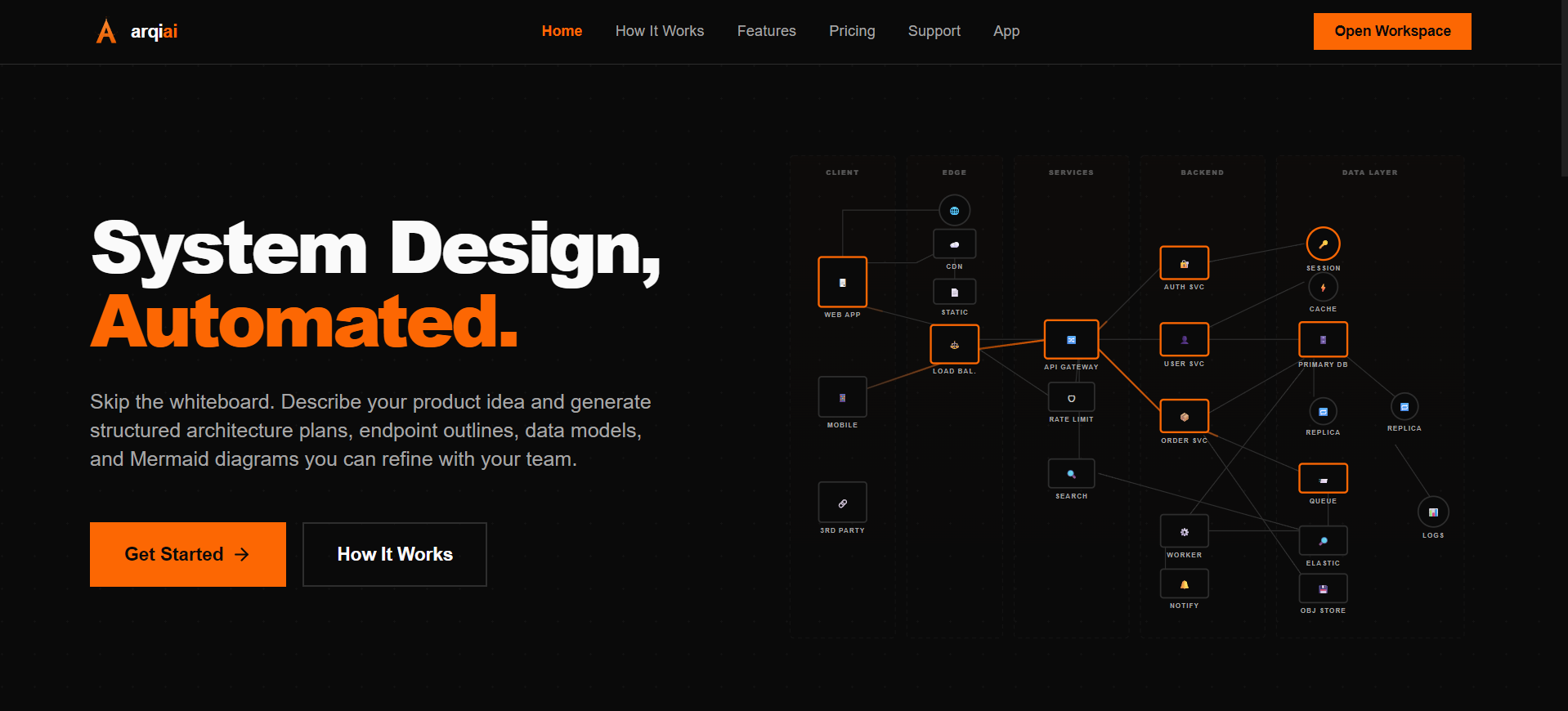
Arqi AI: The Autonomous System Architect — Interface & System Overview
System Capabilities & Field Deployment Architecture
Live operational specifications, core architectural subsystems, and functional highlights verified across production environments.
Arqi AI is an autonomous system architecture platform designed to bridge the gap between a product concept and high-level engineering implementation. By leveraging Retrieval Augmented Generation (RAG) against a curated knowledge base of industry-leading engineering patterns, the platform allows users to chat with a specialized AI Architect to refine their vision into structured, versioned artifacts. These artifacts include functional requirements, non-functional constraints, and technical system blueprints, complete with automatically generated Mermaid diagrams. The final output is a comprehensive implementation prompt that provides AI-first coding environments with the full architectural context necessary to build the software foundation correctly on the first attempt.
Engineered Subsystem 01
Multi-agent deliberation pipeline separates functional decomposition from infrastructure provisioning.
Engineered Subsystem 02
Topological validator runs AST cycle detection before code emission to guarantee deadlock-free DAGs.
Engineered Subsystem 03
Dynamic canvas viewer allows engineers to inspect, tweak, and recompile system nodes in real time.
Operational Constraint Resolved 01
Unstructured requirements suffer from ambiguity and conflicting scalability constraints.
Operational Constraint Resolved 02
Traditional LLM outputs hallucinate circular dependencies and insecure network topologies.
Operational Constraint Resolved 03
Infra synthesis must conform to strict cloud provider syntax (AWS, GCP, Kubernetes) without manual intervention.
Deterministic Architecture Generation from Unstructured Text
Modern cloud architectures require coordinating microservices, event streams, state machines, and relational schemas. Translating raw product requirements into robust system diagrams traditionally demands weeks of senior architect deliberation and frequently introduces silent failure modes.
General-purpose LLMs fail at complex infra synthesis because they lack topological awareness, hallucinate invalid network boundaries, and struggle to generate valid Terraform, Docker, and schema definitions that respect real-world latency and cost boundaries.
Unstructured requirements suffer from ambiguity and conflicting scalability constraints.
Traditional LLM outputs hallucinate circular dependencies and insecure network topologies.
Infra synthesis must conform to strict cloud provider syntax (AWS, GCP, Kubernetes) without manual intervention.
Multi-Agent Graph Reasoning & AST-Driven Code Generation
Engineered a multi-stage autonomous reasoning pipeline powered by FastAPI and Claude 3.5 Sonnet that parses input briefs into an Abstract Syntax Tree (AST) representing domain boundaries, traffic volumes, and statefulness.
A graph verification engine checks the generated Directed Acyclic Graph (DAG) for circular dependencies, calculates estimated egress costs, and automatically outputs validated Terraform configurations, Docker Compose files, and PostgreSQL DDL scripts.
Multi-agent deliberation pipeline separates functional decomposition from infrastructure provisioning.
Topological validator runs AST cycle detection before code emission to guarantee deadlock-free DAGs.
Dynamic canvas viewer allows engineers to inspect, tweak, and recompile system nodes in real time.
Structural Bill of Materials & Pipeline Flow
Execution Pipeline Sequence[ 01 → 05 ]
Production Benchmarks & Empirical Lab Test Plates
Average end-to-end architecture generation
Terraform & Docker compilation pass rate
Reduction in initial system design phase
Simultaneous microservice nodes supported